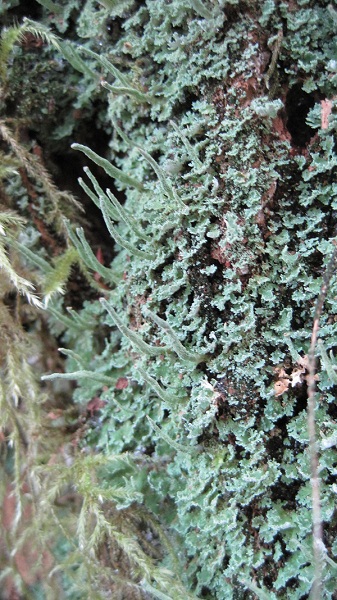
As a member of the genus Cladonia, C. ochrochlora has both a primary and secondary thallus. The primary squamules are large measuring 3 to 6 by 3 to 7cm in dimension and have an entire to slightly dissected margin. The secondary thallus, known as the podetia, are unbranched, standing 10 to 35mm tall, have a green-gray to olive colored cortex, rarely displaying brown. The shape of the podetia is variable, ranging from club shaped to cylindrical. At the very top of the podetia, narrow cups sometimes form that are no wider than the podetia. The cortex of the podetia is continuous on the lower half turning powdery with asexual soredia on the upper half. Sexual apothecia are known to occuring, appearing as brown disks, but are very uncommon.
C. ochrochlora is typically found using decaying wood as a substrate, and can be found on the ground, though rarely.
The geographic distribution includes the northern California coast, the Oregon coast to southern coastal Alaska. Eastward the distribution extends through, British Columbia, Washington, northern Idaho and northwest Montana. In the eastern United states, C. ochrochlora appears in northwestern South caroline and runs through the Appalachian Mountains clear to Maine and southeastern Quebec. In the Pacific Northwest, the occurence of C. ochrochlora is very common in forested areas, both shaded and unshaded.
C. coniocraea can be confused with C. ochrochlora, though an easy distinction to find is the undivived primary squamules and narrow cups of C. ochrochlora versus the dissected primary squamules and pointed podetia of C. coniocraea.
The common name of C. ochrochlora is smooth-footed powderhorn.
Brodo, I.M., S.D. Sharnoff and S. Sharnoff (2001) Lichens of North America. Yale University Press, New Haven, Connecticut.
McCune, B. and L. Geiser (2009) Macrolichens of the Pacific Northwest. Oregon State University Press, Corvallis, Oregon.