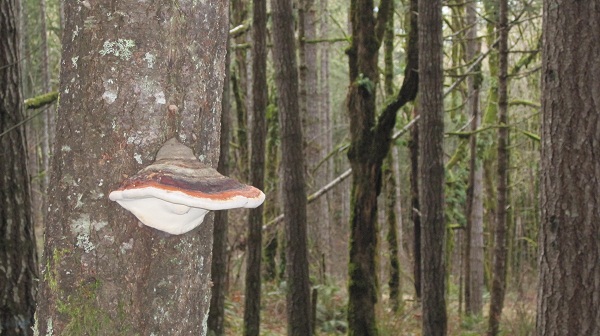
The fruiting body of Fomitopsis picola emerges from dead trees, logs and stumps as a whites or light yellow knob. This shelf fungi will eventually become fan shaped, measuring 5 to 40cm broad and 3 to 22cm thick, with no stalk. The common name is Red Belted Conk in reference to the colors of the cap, typically display reds but can also have brown, maroonish or brown colors, especially toward the base. The colors are brighter at the margin of the cap as this is the actively growing edge and the colors dull and darken with age. As the cap grows, concetric zones are formed and each are rounded. Growth of the cap is continuous from spring to the first freeze in fall. The flesh has a tough texture and bruises pink in actively growing areas. The odor is very strong and ‘fungal’, though has also been likened to the smell of tobacco. The underside of the cap has 3 to 5mm diameter, round pores, as is typical of Polyporaceae family members.
F. pincola is a parasite, attacking the heartwood and sapwood of the host tree, producing a slow carbonizing rot that fractures and browns the wood. When the wood is fracture, extensive mats of mycelia can often be seen. F. pincola is a major destroyer of coniferous timber.
F. pincola is inedible due to woody texture and bitter, acidic flavor, though some claim to have eaten it.
The occurence of F. pincola is very common and widely distributed. The bright red marging makes this species easy to identify.
Synonyms of F. pincola include Fomes pincola and Ungulina marginata.
Arora, D. (1986) Mushrooms Demystified. Ten Speed Press, Berkeley, CA.
Lincoff, G. (Ed.) (1981) Simon & Schuster’s Guide to Mushrooms. Simon & Schuster Inc, New York, New York.