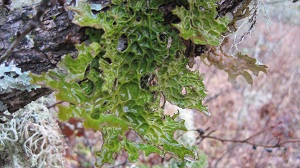

Lobaria pulmonaria, commonly known as Lungwort, is a large, loosely attached, foliose machrolichen 5 to 15 cm across. The lobes of L. pulmonaria are broad (20 to 30mm across) with strong ridges, being deeply indented between ridges. The upper surface of the thallus is pale blue-green when dry and bright green when wet. The lower surface of the thallus is brownish, finely haired and has scattered white hairless patches. Asexual reproductive propagules, soredia and isidia, are produced along the ridges and lobe margins. Lobules can be produced on productive species. Apothecia are sometimes produced but uncommonly seen.
L. pulmonaria is epiphytic and dwells in humid forests, both coniferous and deciduous, of lower elevations. This species is commonly found in areas of old growth and is associated with unpolluted areas. Sometimes L/ pulmonaria is found on mossy rocks.
The species distribution includes Alaska southward to central California, inland to western Montana. Occurance is frequent west of the Cascade Mountain Range and uncommon elsewhere. L. pulmonaria is the most widespread species of Lobaria.
Early European physicians and natives used L. pulmonaria to treat pneumonia, tuburculosis and lung diseases based on the theory that resemblance to the body parts will treat the illness. It has been used in brewing in India. In the northeast, L. pulmonaria is a favorite food of moose.
Brodo, I.M., S.D. Sharnoff and S. Sharnoff (2001) Lichens of North America. Yale University Press, New Haven, Connecticut.
McCune, B. and L. Geiser (2009) Macrolichens of the Pacific Northwest. Oregon State University Press, Corvallis, Oregon.
Pojar, J. and A. McKinnon (1994) Plants of the Pacific Northwest Coast. Lone Pine Publishing, Washington, Canada.