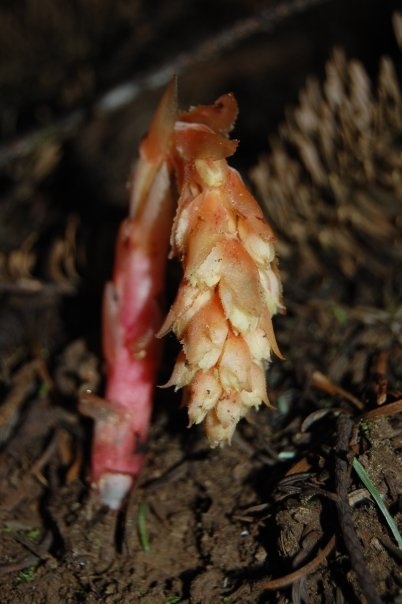
Monotropa hypopitys, ‘Pinesap’, is a member of the Ericaceae plant family, also containing Rhododendron sp. and Salal. M. hypopitys is part of the achloropholous group within this family requiring the saprophytic lifestyle. The stem stands unbranched up to 30 cm tall with small scale-like, lance shaped leaves that are 3 to 6 mm long. The leaves tend to be thick and crowded near the base of the stem. Lacking chlorophyll, the entire plant is yellowish to pinkish in color, drying to black when senescent. As typical of the Ericaceae family, the flowers have fused petals forming a sac-like base, extending 1 to 2 cm and can be hairy on one or both sides of the petals. Several (3 to 5) flowers are born in terminal clusters that are nodding. The fruit produced are brown in color, erect, oval to round capsules that are up to 8 mm long and split open when dry
The common name ‘Pinesap’ refers to the tendency of M. hypopitys to grow beneath pine trees, or conifers in general as well as the saprophytic lifestyle and the sapping of energy from the trees under which it grows. A third possible explanation is the resemblance of the flowers color and texture to congealed pine resin. The Latin name comes from ‘hypo-’ meaning beneath and ‘pitys-’ meaning trees. The specific epithet refers to the flower facing in a single direction.
Hitchcock, C.L. and A. Cronquist (1994) Flora of the Pacific Northwest, University of Washington Press, Seattle and London.
E.N. Kozloff (1976) Plants and Animals of the Pacific Northwest. University of Washington Press, Seattle and London.
Pojar, J. and A. McKinnon (1994) Plants of the Pacific Northwest Coast. Lone Pine Publishing, Washington, Canada.