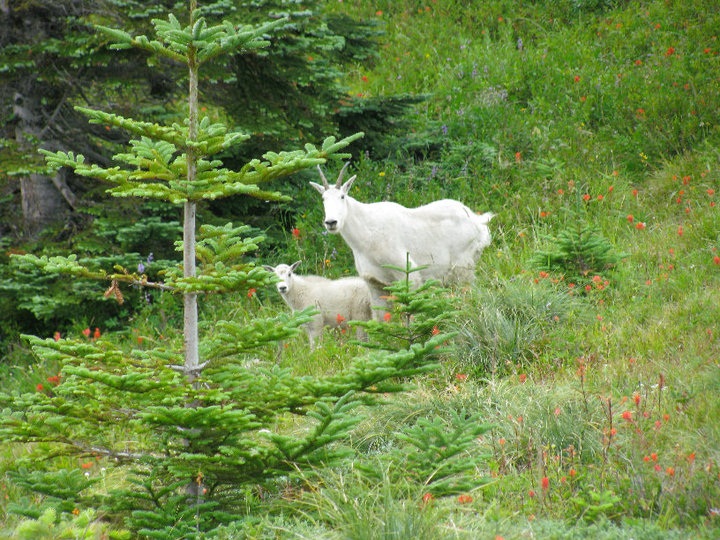
The mountain goat, known in latin as Oreamnus americanus, has a long, white, shaggy winter coat that becomes shorter in the summer when the heat arrives. The winter coat over the body consist of long guard hairs that cover a dense fleece-like undercoat while the legs have a shorter covering of hair, making the animal look as though it is wearing pants. The black lips, nose, eyes, hooves and horns contrast sharply with the white coat. The body is thick, stocky and humpshouldred on top of slender agile legs.The males, or billies, are 1.2 to 1.8m long by 8 to 20cm wide and weigh 46 to 136kg. The females, or nannies, have a smaller body, measuring 1.3 to 1.5m long by 8 to 14cm wide and weigh between 45 to 83kg. Both sexes have slightly curved black horns though the males are longer, thicker and have a continuous arc backwards while those of the female are narrow, extend straight from the head and bend backwards sharply hear the horn tip. Both sexes have a distinct beard that grows longer in the winter. Billies display and fight in order to establish dominance hierarchies and gain access to a female.
The breeding season runs from November to January. Nannies give birth to a sinlge precocious kid from May to June, occasionally having twins. After birth, the young stay with their mothers until the next birth occurs, though the mother only lactates through the fall after a birth. The kids will begin to eat vegetation after only a few days, but will not be completely weaned until around 6 weeks of age. At the age of the 3, the female is sexually mature, while the male matures later. The nannies mate alternating years. The life expectancy of O. americanus is up to 20 years in the wild.
The mountain goat migrates between the upslope in the summer and the downslope at the first sight of snow. The typical habitat includes steep slopes and rocky cliffs in alpine and subalpine areas. Treeless areas are frequented by O. americanus more often than forested regions though salt needed during molting can be a strong attractant into a less desireable area Forage for O. americanus includes shrubs, mosses, lichens, forbs, grasses, sedges and rushes. Shallow depression near the bases of cliffs are signs of O. americanus as they bed down in these ares often leaving clumps of hair behind from molting. In the summer dusting pits are dug.
O. americanus is famous for the ability to climb on steep, rocky cliffs. This ability is a necessity for refuge from predators, when feeding in the open meadows above timberline and made possible through three essential traits. The hooves have a hard outer ring surrounding a soft spongy center allowing the animal to grip surfaces. Dewclaws are present and long enough to touch the ground when on soft surfaces, providing extra balance. The winter coat with fleece under and protective guard hairs aid in survival during subzero temperatures and high winds.
The range of O. americanus has a northern bound in southern Alaska and eastern Yukon, extending south through the Cascade and Olympic Mountain ranges, and the Rocky Mountains into Idaho and Montana. In eastern Oregon, an introduced population exists.
Kays, R.W. and D.E. Wilson (2009) Mammals of North America. Princeton University Press, Princeton, New Jersey.
Eder