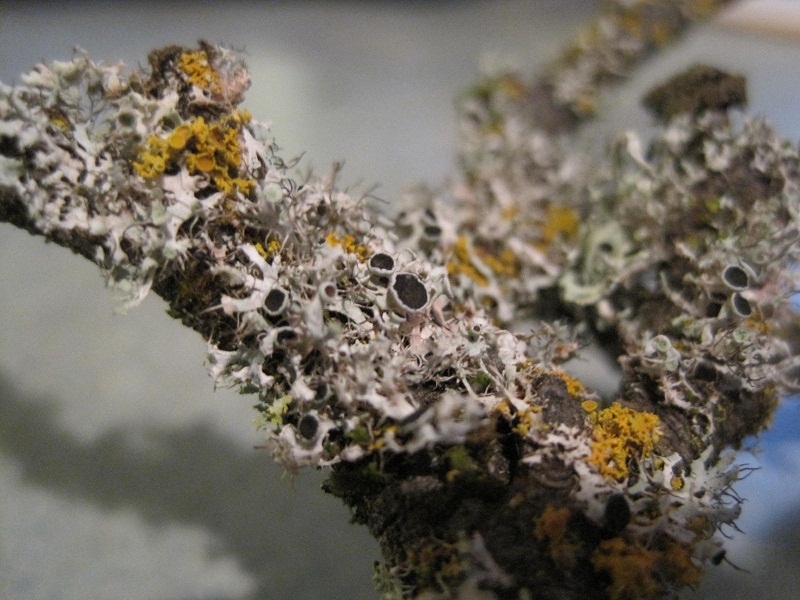
The thallus of Physcia aipolia a small, 1 to 3mm diameter, foliose lichen with narrow, radiating, flattened lobes. Though the lobes are largely appressed, barely appearing foliose, the lobes overlap slightly and turn up at the tips. The thallus is light to dark gray and is spotted with white maculae. Reprodcution is achieved sexually via 1 to 3 mm diameter, dark brown but heavily pruinose apothecia. The lower thallus surface is white to tan and display many light colored rhizines that are sparsely to densely distributed.
The typical substrate of P. aipolia is the bark and wood of trees, several species, in open habitats.In the Pacific Northwest, P. aipolia is widespread and common west of the Cascade mountains, rarely occuring on the east side. The gray thallus of this species is a common sight in urban and agricultural areas.
The species P. stellaris occurs in the same geographic range as P. aipolia though it does not have white maculae on the thallus and has flat to convex lobes. The occurance of P. aipolia on the west side of the Cascade range is greater than that of P. stellaris and vice versa on the eastern side. In the Pacific Northwest, the distinction between the two species is best observed in a K test, or a chemical reaction test indicating presence or abscence of certain secondary compounds, as the presence of maculae is not consistent.
Brodo, I.M., S.D. Sharnoff and S. Sharnoff (2001) Lichens of North America. Yale University Press, New Haven, Connecticut.
McCune, B. and L. Geiser (2009) Macrolichens of the Pacific Northwest. Oregon State University Press, Corvallis, Oregon.