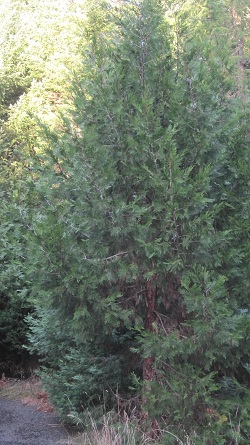

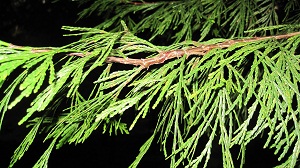
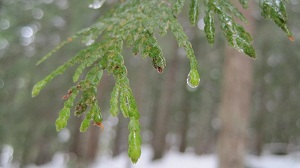
Thuja plicata, commonly known as Western Redcedar or giant arborvitae, is a large tree to 60m tall with a drooping leader and branches that droop slightly as they spread out from the trunk, turning upward toward the ends forming a narrow conical outline. Branchlets spray flatly out horizontally. The bark is gray to reddish brown, thin, ridged or fissured lengthwise, tearing off in long fibrous strips. At the base of the trunk, a mature tree is strongly fluted or buttressed. The wood of the trunk and the leaves are characteristically aromatic, the leaves releasing a sweet aromatic scent when crushed. Leaves are scale-like, arranged oppositely in dimorphic pairs, where the leaves of one pair are folded and the leaves of the second not folded, all being closely pressed to the stem overlapping one another. The resulting appearance of the leaf arrangement is of a glossy yellow-green flattened braid. When leaves have reached approximately three to fours years of age, the color will turn to brown and shed from the tree. The male cones are minute in size (approximately 8mm long), subglobose in shape, numerous on a tree and reddish in color. The female cones are 8 to 12 mm long and composed of 4 to 5 egg-shaped scales with small hooked spines approximately 1mm in length. Cones are arranged in loose clusters. At immaturity, female cones are green becoming woody, brown and scales turning upward in the autumn when maturity is reached. Seeds are produced in the female cone and are winged.
Western Redcedar trees are typically found in the moist to wet soil of shaded forests. Growth has been observed best at seepage or alluvial sites, but the tree has been known to occur on drier sites when soils are rich. The speceis is a major component of moist, lowland coniferous forests. Particularly long lived, specimens have been found of Western Redcedar that are over 1000 years old
Western Redcedar is distributed throughout low to mid elevations, from Alaska to Humboldt County, California. The range starts at the coast and moces inland to southeast British Columbia and northwestern Montana.
Historically, this tree has been much utilized and has been referred to as the cornerstone of northwest coast Indian culture. The wood is easily split and also rot resistant making it ideal for any item that could be manufactured from wood. Indians made canoes, house planks and posts, totem or mortuary poles, bentwood boxes, baskets, clothing, hats, tools, dishes, arrow shafts, harpoon shafts, spear poles, barbeque sticks, fish spreaders and hangers, dipnet hooks, fish clubs, masks, rattles, benches, cradles, coffins, herring rakes, canoe bailers, ceremonial drum logs, combs, fishing floats, berry drying racks, fish weirs, spirit whistles and paddles out of Western Redcedar wood. Because the wood is straight grained, soft and easy to work with it is an important timber species, with many cultivars developed.
Hitchcock, C.L. and A. Cronquist (1994) Flora of the Pacific Northwest, University of Washington Press, Seattle and London.
Pojar, J. and A. McKinnon (1994) Plants of the Pacific Northwest Coast. Lone Pine Publishing, Washington, Canada.
Rushforth, K. (2004) A Falcon Guide: The Easy Tree Guide. Falcon CT, MT.
Russel, T., C. Cutler and M. Walters (2006) The New Encyclopedia of American Trees. Hermes House, London.