
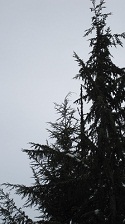
Tsuga heterophylla, commonly known as Western Hemlock, is a tree standing up to 60 m tall, has a narrow crown, a drooping leading and branches that fall gracefully sweeping away from the trunk. The bark of the trunk is reddish-brown, rough textured, thick, scaly and developing furrows with age. The inner bark is red. The foliage is feathery and built from short, flat, yellow-green, unequally lengthed (5-20 mm) needle-like leaves with blunt tips. New leaf growth is bright green appearing in the spring. The lower surface of the leaves are lined with two white rows of stomata. The twigs are thin and have persistant pegs where the leaves were once attached. The base of the leaves are twisted giving the appearance of being two ranked. Males cones are very small (3 to 5 mm), appearing in spring and numerous, spreading much pollen. The female cones are comparatively larger, though only approximately 2 cm long, oblong shaped, borne in autumn, purple-green when juvenile maturing to light brown.
Western Hemlock inhabits moderately dry to wet sites, thriving in humus and decaying wood, sometimes persisting in mineral soil but never raw floodplains or recently deglaciated sites. As one of the most shade tolerant species of tree on the Pacific coast, Western Hemlock can survive under the canopy of more dominant trees. In a pure stand, Western Hemlock has one of the densest canopies and therefore,few understory plants by the time the stand is 30 to 80 years old.
The range of Western Hemlock runs from Alaska south to northern California along the Pacific coast. It is also found in southern British Columbia and northern Idaho.The tree is hardy and thrives in the Rocky Mountains up to 6,000 ft (1,830 m).
There have been many historic uses for Western Hemlock by the Native Americans. The high tannin content of the bark has been utilized as a tanning agent, facial cosmetic, hair remover, pigment and cleansing solution by Native Americans. The wood is moderately heavy, durable and easy to carve making it useful in the construction of spoons, roasting spits, dip net poles, combs, spearshafts, wedges, children's bowsets, baskets and bowls. The branches were utilized as bedding material and constructing bough hut, were women resided in the four days following their first menstruation. Clothing was also produced from various parts of the tree. Medically, it was used topically as a poultice, linament and sunscreen when combined with deer tallow. A tea was made to heal internal injuries and bleeding. The inner bark was sometimes eaten in a form of bread. Western Hemlock has the highest growth rate recorded in the temperate zone forests (36 tons/hectare/year) and is an important timber species.
Hitchcock, C.L. and A. Cronquist (1994) Flora of the Pacific Northwest, University of Washington Press, Seattle and London.
Kozloff, E.N. (1976) Plants and Animals of the Pacific Northwest. University of Washington Press, Seattle and London.
Pojar, J. and A. McKinnon (1994) Plants of the Pacific Northwest Coast. Lone Pine Publishing, Washington, Canada.
Rushforth, K. (2004) A Falcon Guide: The Easy Tree Guide. Falcon CT, MT.
Russel, T., C. Cutler and M. Walters (2006) The New Encyclopedia of American Trees. Hermes House, London.